How Mugi works
Five things you can check afterwards
Five specific things that either happened in your appointment or did not, short enough that you can tell which. They go home with you on the written plan, and they are the reason some appointments end without any tattooing.
- 01
Nothing permanent before you approve it on your own face
The shape is mapped, drawn and adjusted in a mirror until you say yes. There is no cap on adjustments. If we cannot get to yes, the appointment ends without pigment.
- 02
Softer than you expect is the right first pass
Pigment is easy to add and hard to take back. Density is built across two sessions rather than forced into one. If you leave saying it is lighter than you imagined, that is the intended result, and you are told so in advance.
- 03
Nothing is finished before it heals
A result is judged at six weeks or later, in ordinary light, on your face. Fresh work is not evidence. A second session at six weeks is how density is built, not a sign that the first one went wrong.
- 04
No is part of the service
Wrong candidate, wrong technique, wrong timing, wrong expectation: you get the answer early, out loud, with a reason and an alternative. A declined case is a completed piece of work.
- 05
If it cannot be shown, it is not claimed
Every number carries its source and its limit or it does not appear. Every result carries its interval and whether it has healed. No measuring my work against a market average, and no statistics about my own outcomes without the cases behind them.
What can actually go wrong
These are four things that decide how brow tattooing turns out, and three of them are settled before any needle is switched on.
It heals lighter than it looks, and darker before that
Day three is the worst day. The brow is at its darkest and sharpest and looks nothing like the result. Around day five to ten it flakes and goes patchy, then a ghost phase where it looks like almost nothing took. What settles at six weeks is roughly what you keep. It is worth knowing about the day-three stage before you book, so the darkest point does not arrive as a surprise.
Shape is a much bigger risk than colour
Colour drifts and can be adjusted at the second session. A shape that was mapped to a trend rather than to your face is much harder to undo than a colour that drifted. That is why the drawing takes an hour and why nothing starts until you have approved it in a mirror.
Skin behaviour changes what is possible
Artists generally steer oily or large-pored skin towards shading rather than crisp individual strokes, and very dry or mature skin is a separate conversation again. This is not a reason to be talked out of anything, but it is a reason a technique that suited your friend may not suit you.
Existing pigment limits the options
Old work underneath does not disappear because new work goes on top. Some of it can be worked over, some of it needs lightening elsewhere first, and some of it is better left to fade. Which of those applies cannot be judged from a description, so old work is looked at in person before anything is agreed.
When this is not the right studio for you
Worth reading before you book rather than after. None of these is a judgement; they are just cases where you would be better served somewhere else, or later.
- —You want the brow you saw on TikTok, on a face that is not yours.
- —You want it dense and defined on day one. That is achievable and it is not what is done here.
- —You need it finished before an event next week. It takes two sessions and six weeks.
- —You have existing permanent makeup that needs lightening first, and you do not want to do that step.
- —You want a fast appointment. The first hour is the product; it cannot be compressed.
- —You are pregnant or breastfeeding, or you have a skin condition in the brow area that is currently active.
The fuller version, including conditions and medications that mean waiting, is on the page about who this suits.
The part that should be boring
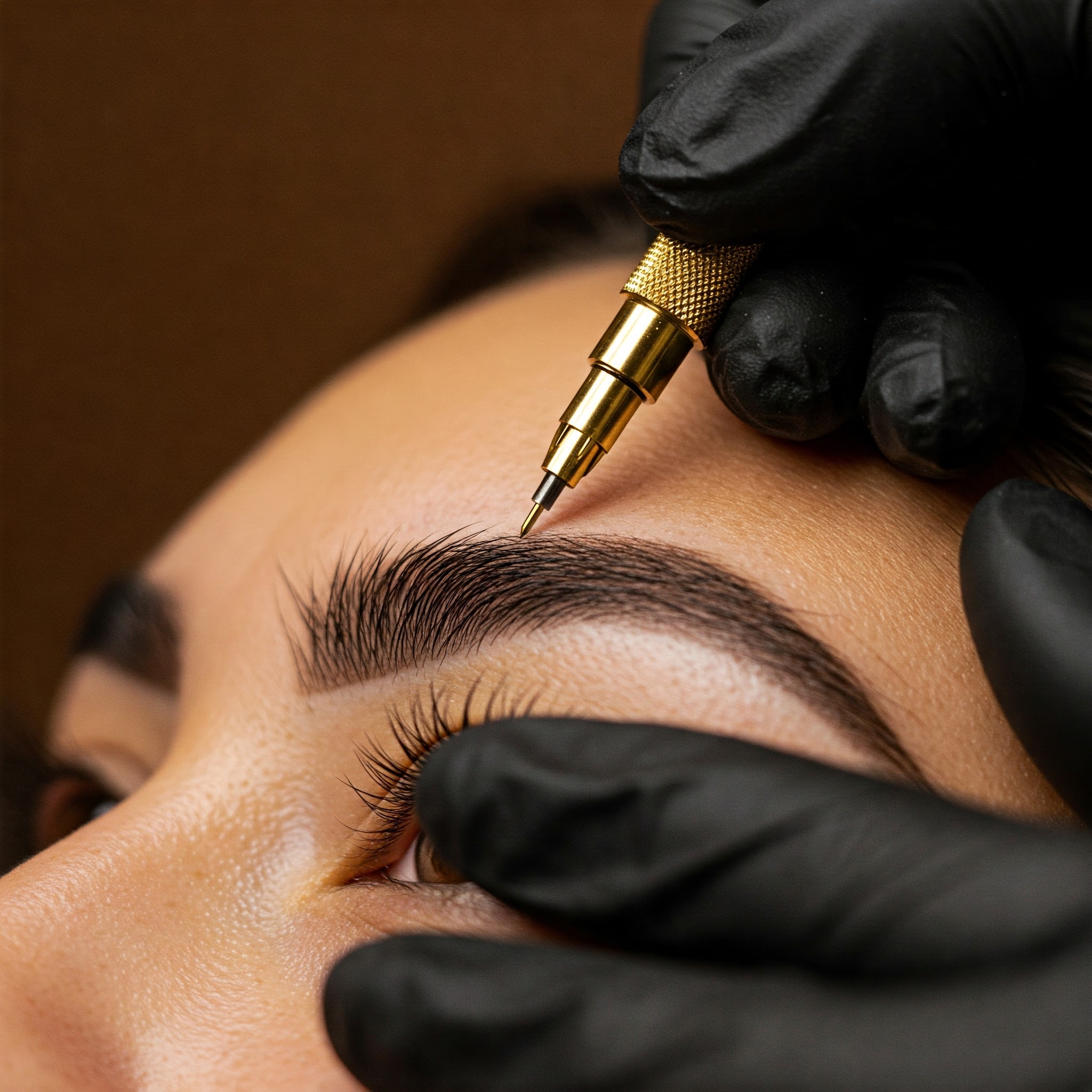
Single-use needles and cartridges, opened in front of you and disposed of afterwards. Fresh gloves, a covered work surface, and a licence number you can check with the state yourself.
If you are still deciding
You do not have to know what you want before you get in touch. Send a photo of your brows and what is bothering you, and you will get an honest read back - including if the answer is that you should wait, or choose something else.
A question, and a photo only if you want to. Mugi reads it and answers herself.